Let’s talk about something most of us learned to whisper about — if we talked about it at all. Masturbation. For women, it still comes wrapped in a knot of old myths: that it isn’t ladylike, that it means something is missing, that reaching for a toy is somehow “cheating” on a partner. I’ve believed a few of these myself over the years. So today I want to gently pull them apart, one by one, with what the research actually says. ✨
First, the truth: this is normal — extremely normal
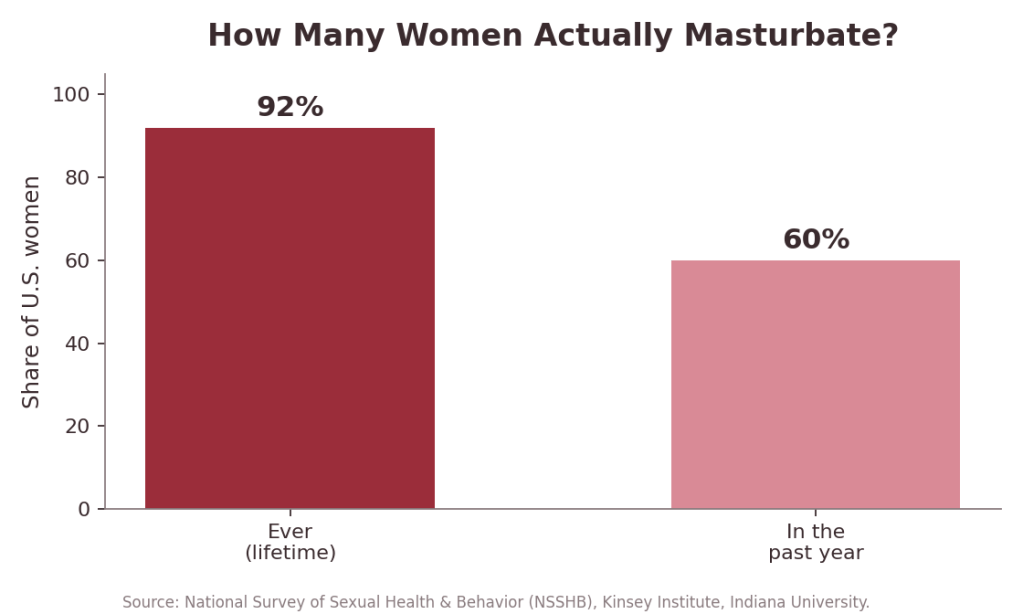
Here’s the number that reframed everything for me. According to the National Survey of Sexual Health and Behavior (NSSHB), one of the largest nationally representative studies of its kind, about 92% of women have masturbated at some point in their lives, and roughly 60% have in the past year. If it feels like “nobody talks about it,” that’s the taboo talking — not reality. Almost everyone is quietly in on the secret.
Myth #1: “It’s not ladylike”
This one is pure inheritance — a script handed down from a time when women’s pleasure was treated as inconvenient or improper. But there’s nothing “unladylike” about knowing your own body. Cleveland Clinic describes masturbation as a normal, healthy part of human sexuality at any age. The only thing that isn’t serving us is the shame we were taught to feel about it. Tending to your own pleasure isn’t a lapse in manners — it’s a form of self-respect.
Myth #2: “It’s bad for your health”
The generations-old warnings — that it makes you ill, “uses up” your orgasms, or damages your body — have no scientific basis. Planned Parenthood is blunt about it: masturbation won’t make you blind, it won’t harm your genitals, and it can’t cause an STI or pregnancy, making it the safest sex there is. If anything, the research points the other way. Cleveland Clinic notes that regular sexual activity, including solo, is linked to higher levels of immunoglobulin A (IgA), an antibody that helps your body fight off everyday illness. Orgasms can also ease stress, support better sleep, and — yes — help with menstrual cramps.
Myth #3: “Only single or unhappy women do it”
Masturbation isn’t a consolation prize for being alone. Women in loving, satisfying relationships masturbate too — and it doesn’t signal that anything is wrong. It’s simply a different flavour of pleasure: yours alone, on your terms, no negotiation required. And this holds across a lifetime. A study of older adults across four European countries found that a meaningful share of women continue to enjoy solo pleasure well into later life, partnered or not. Desire doesn’t have an expiration date.
Myth #4: “Toys replace partners”
This is the one I hear most, and it’s worth retiring for good. A vibrator is not a rival — it’s an instrument. It helps you learn what your body responds to: the pace, the pressure, the kind of touch that actually works for you. And that knowledge is a gift you can bring into partnered sex, not a wall between you and it. Research consistently finds that women who explore their own pleasure tend to report higher arousal and orgasm frequency with partners, and feel more comfortable asking for what they want. Toys don’t replace intimacy. They deepen it.
By the numbers
| Stat | What it tells us |
|---|---|
| ~92% of women have masturbated in their lifetime | It’s the norm, not the exception (NSSHB) |
| ~60% did so in the past year | It’s an ongoing part of many women’s lives |
| Higher IgA antibody levels linked to regular sexual activity | A possible immune-support benefit (Cleveland Clinic) |
| 0 risk of STIs or pregnancy | The safest form of sex there is (Planned Parenthood) |
Where YourLibet comes in
Every one of these myths does the same quiet work: it puts distance between women and their own pleasure. That’s exactly the gap we built YourLibet to close. We’re designing an AI-powered device that learns what your body responds to — so exploring yourself feels less like guesswork and more like a conversation with a body that’s finally being listened to. No shame, no scripts, no apology. Just you, getting to know you. ✨
— Sāra, YourLibet Co-Founder
References
- Kinsey Institute, Indiana University — National Survey of Sexual Health and Behavior & trends in masturbation prevalence. news.iu.edu
- Cleveland Clinic — “Masturbation: Facts & Benefits.” my.clevelandclinic.org
- Planned Parenthood — “Is Masturbation Good For You?” plannedparenthood.org
- Träen B. et al. — “Prevalence of Masturbation and Associated Factors Among Older Adults in Four European Countries,” Archives of Sexual Behavior (via NCBI/PMC). ncbi.nlm.nih.gov
 YourLibet
Leave a comment