Let me tell you something I wish someone had told me years ago: the words “a little to the left” are not a criticism. They’re a gift. ✨
If the thought of actually saying what you want in bed makes you want to disappear under the duvet, you are so deeply normal. Most of us were never taught how to talk about pleasure – not in school, not at home, definitely not in the movies. So we lie there hoping our partner will magically read our minds, and then feel a quiet little disappointment when they don’t. I’ve been there. A lot of us have.
Here’s the plot twist, though: learning to speak up is genuinely the closest thing we have to a cheat code for better sex. And the awkwardness? It’s real, it’s common, and it fades a lot faster than you’d think.
You’re not alone in finding this hard
First, let’s normalize the squirm. In a survey of over a thousand women, 55% said they chose not to talk about sex with their partner even though they wanted to. More than half! Across several European countries, roughly one in four people said they find it genuinely difficult to talk about sex, fantasies, and desires – and up to half said they secretly wish they were better at it.
So if you’ve ever swallowed the words right before they left your mouth, you’re in extremely good company. The awkwardness isn’t a personal flaw. It’s a cultural inheritance – and inheritances can be returned.
Why speaking up matters more than we admit
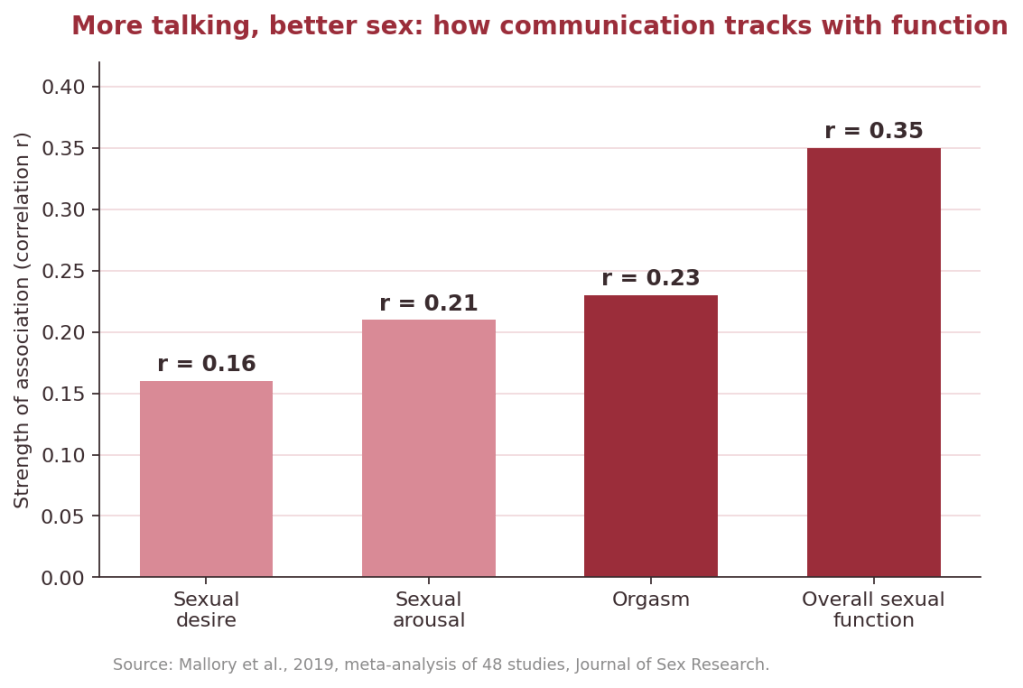
Here’s where it gets motivating. A big meta-analysis pulling together 48 separate studies found that couples who communicate more about sex report better sex across the board — more desire, more arousal, and notably more orgasms. The link to orgasm was actually stronger for women than for men. Talking isn’t a mood-killer; it’s practically foreplay.
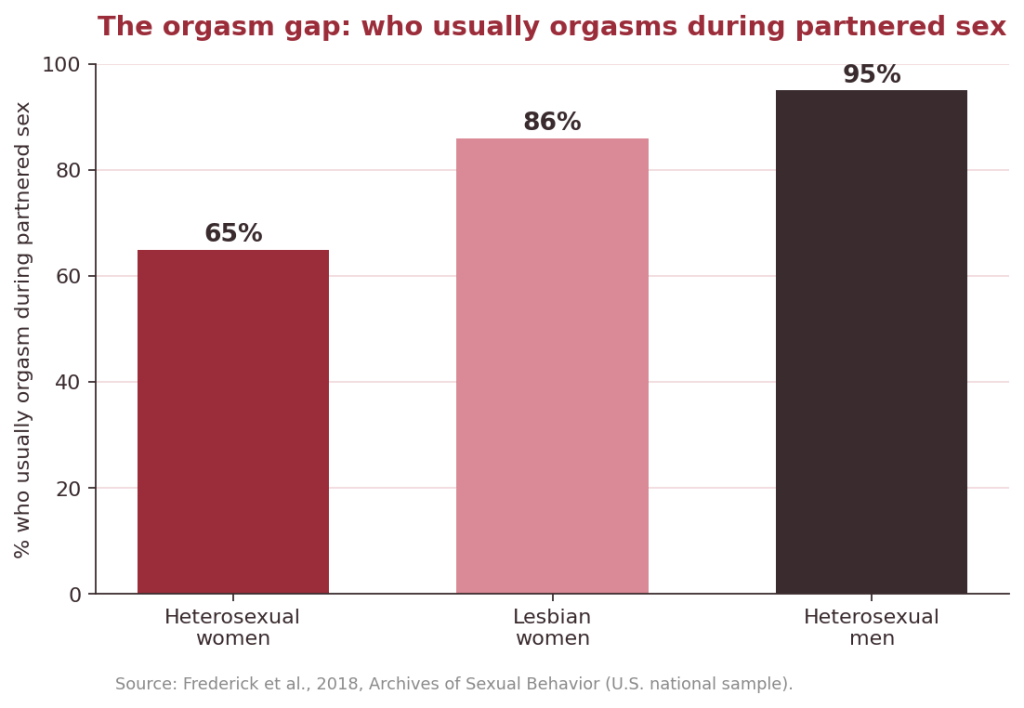
This matters because the orgasm gap is real. In a large U.S. study, only about 65% of heterosexual women said they usually orgasm during partnered sex, compared with 95% of heterosexual men. Notably, women who are more assertive about what they want tend to close that gap for themselves. Your voice is one of the most powerful tools you’ve got.
By the numbers
| The stat | What it means |
|---|---|
| 55% | of women avoid talking about sex with their partner — even when they want to |
| ~1 in 4 | people say they genuinely struggle to talk about sex, fantasies, and desires |
| Up to 50% | secretly wish they were better at communicating about sex |
| 65% vs 95% | heterosexual women vs. men who usually orgasm during partnered sex |
| Stronger for women | the boost that sexual communication gives to orgasm (across 48 studies) |
How to actually say it (without dying of embarrassment)
1. Talk outside the bedroom first
The pressure of a live, in-the-moment conversation is a lot. Try bringing it up on a walk, in the car, over coffee – somewhere low-stakes and clothed. “I read something interesting about couples who talk about sex having better sex, want to try it?” is a shockingly good opener.
2. Lead with pleasure, not problems
Nobody wants to feel graded. Frame it around what feels amazing rather than what’s missing: “I love it when you…” lands so much softer than “you never…”. Then you can gently add, “…and I’d love to try more of this.”
3. Use the in-the-moment shortcuts
Full sentences are optional. A breathy “yes, there,” guiding their hand, a happy sound, or a simple “slower” all count as communication. You don’t need a TED talk – you need feedback.
4. Get curious about yourself first
It’s genuinely hard to ask for what you want if you’re not sure what that is. Solo exploration – with your hands, or a toy – is how a lot of us build the map we later hand to a partner. You can’t give directions to a place you’ve never been.
Asking for what you want isn’t demanding. It’s an invitation – and most partners are relieved to finally get one.
A little nudge from us
At YourLibet, we believe your pleasure deserves the same clarity, confidence, and care you bring to everything else in your life. Knowing your own body – what you like, how you like it – is the foundation that makes those bedroom conversations feel less like a nerve-wracking exam and more like sharing something you’re genuinely excited about. That’s exactly the kind of self-knowledge we’re building tools to support. ✨
Start small. Say one true thing this week. The awkwardness is temporary; the better sex is not.
— Sāra, YourLibet Co-Founder
References
- Mallory, A. B., et al. (2019). Couples’ Sexual Communication and Dimensions of Sexual Function: A Meta-Analysis. The Journal of Sex Research.
- Frederick, D. A., et al. (2018). Differences in Orgasm Frequency Among Gay, Lesbian, Bisexual, and Heterosexual Men and Women in a U.S. National Sample. Archives of Sexual Behavior.
- Træen, B., et al. (2024). Sociodemographic Predictors of Sexual Communication and Sexual Communication as a Predictor of Sexual, Relationship, and Life Satisfaction. Sexuality & Culture.
- Kerner, I. (2021). Why Many Women Hide Their Sexual Desires. Psychology Today.


Leave a comment